Things often aren't what they seem to be.
I went to a competitive business school. Not in the sense that it was hard to get into, but in the sense that my classmates really always wanted to win. I wasn't an exception: to gain an edge on the Shad Exercise, I committed my first effective act of corporate espionage, lingering by the judging area while a team with an earlier start time made their attempt. We had a fair number of in-class simulations, too, where a group of students made their pitch in response to whatever the case of the day way. Some of those were un-judged, but we couldn't have that. We wanted to know who won! Typically, the professors would let us vote for a winner, with the simple rule that no one could vote for their own entry. We thought the lesson would be in why the winning team won, so we'd always ask the professor. One of them got tired of this, and, when asked yet again why the winning crew earned their non-existent trophy, finally snapped, "the winners are always the ones who went last." He was right. We typically were so caught up in our own presentation, that we never focused until it was over. The group who went last had everyone's attention and we voted for what we best remembered. Occam's razor approves. But the competitors and voters couldn't quite tell that this is what was going on and the unraveling of the plot surprised even the most cunning among us.
What does it take to see what's really going on? You have to be aware enough to pick up all of the details and sharp enough to discard the ones that don't matter; you have to be able to come up with a pile of explanatory theories and just as quickly be willing discard the ones that don't fit. The mental flexibility shown by the ones who figure it out first is remarkable.
I'm easily hoodwinked by new details. In those business school simulations and presentations, I'd hear one interesting idea and, being excited by it, cast my vote assuredly and then be completely surprised when the last presentation inevitably beat the one I'd favored. This trait makes it fun to read: a new, interesting thing captures my attention and makes me want to tell you all about it! It's a bit harder, though, for me to discern what actually matters or is really going on. Often, when sifting through the stack of articles in the "could work for a Friday email" pile, I'll find articles that had a sell-by date or, more curiously, directly conflicting narratives. It takes the unfolding of time and, related, some consideration for me to identify what is going on below surface.
Consideration is that mode of thought that sees not just the details, but also the bigger picture in which they fit and the internal logic of what makes it all come together. That takes time we typically don't see in the pieces we read online. Journalists love new details and rarely consider larger or deeper themes emerging details might suggest, especially if what's emerging offers counter-evidence to the prevailing narrative. Essayists and thought leaders typically can't be bother to do much more than articulate their biggest, best picture. While entertaining, there's usually any amount of detail that offers support for the opposite conclusion. (Cal Newport never met a social media tool he didn't like, he tells you on his YouTube channel.) The closest we sometimes come is longer-form pieces that combine consideration of detail, big picture, and enough 'on the other hand'-ing to support the image of an octopus as the mind of the writer.
For the links this week, we have two examples of the sort of attempt to find and show what's really going on and one counter-example. The counter example could be the most fun to read. An NYT reporter, so excited to find the first billion-dollar, AI-driven company with no employees, fails to spot a scam: the business is a fly-by-night advertiser, selling the kinds of drugs that ought to be illegal, or selling them in a way that is illegal. The "business" didn't produce anything or fulfill anything: the ultimate middleman. The innovation: there were no middlemen, only computer programs and contractors. The TechDirt writer has a lot of fun with the Times reporter's mistake, showing us the details, the big picture, and the internal logic of what's actually going on.
Enjoy the reading!
Reading
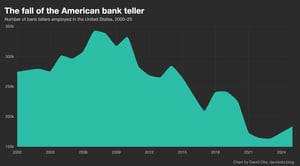 Why ATMs didn't kill bank teller jobs, but the iPhone did
There's a lot more to replacing labor than just automating tasks
 Is Psychiatry Keeping Us Sick?
On the iatrogenic effects of psychiatry. Something is deeply wrong with the mental health system. Instead of leading to recovery, it often perpetuates cycles of dependency on therapy, medication, and diagnoses.
 The New York Times Called a Telehealth Scam the Future Of AI
The story is making rounds, and giving people the impression that with a ChatGPT account and a little bit of marketing know-how, you too could be raking in millions every month. The problem is that most of the story is utter nonsense.