One of my more privileged complaints was over the length of the walk back to my Dad's secret free parking spots after sports games. The place behind Foxboro Stadium was probably two miles away from the gates, which felt a whole long longer after a January night game. (Yes, the tickets he bought were often playoff tickets—the complaints were privileged!) The parking spots for Red Sox games were a good ways through the Fenway itself, at a Brookline stop along the green line trolley. We didn't take the trolley, though, we walked. You could blame Frederick Law Olmstead for how long that walk felt: the paths are always curving and the vistas always of foliage and water. This was back before baseball games proceeded at their current maniac pace and we always got there for batting practice. A mile or two of walking afterwards could make the event feel interminable. That we had prime seat after prime seat didn’t stem the tide of my grumbling.
Those old muttered complaints came back to haunt me a few weeks ago. Three generations of Red Sox fans, the latest ones just in the making, journeyed to Fenway Park along a path of my improvisation: we parked at the HubSpot office and took the trolley across town. This was my fancy improvisation on the old ways. The new plan was promising on the way there and awful on the way back. Thanks to crowds and the T's old-fashioned speed, it took us an hour to get to the car; thanks to some overnight construction on the Tobin, it took us another hour to get home. Thanks to baseball's new breakneck speed, we spent more time going home than watching a classic Red Sox win. Inadvertently, I had passed on my old complaint to my sons: why can’t we just pay for a parking spot close to the ballpark? I might’ve given it to my Dad, too.
It’s funny, what we offer as an inheritance.
For the read today we have three essays on what we pass along to the next generation and how we do it. The first is about a lack of sports heritage. Ross Douthat grew up a frustrated Red Sox fan, but something about his peregrinations into the middle Atlantic and the hometown team’s private equity-backed decades of winning removed him from fandom. His kids are growing up without a spiritual—I mean sporting—heritage. Even though he takes them to Fenway, there’s no listening to the team on the radio, looking up the box score in the morning paper, nor any of the other rituals of 1990s fandom. This struck home with me: Aunt Shirl never watched the games on TV, that being an invention that postdated her fandom, but she always read the scores in the paper and, the teasing of her youngest son confirmed, a crush on longtime Red Sox radio broadcaster Joe Castiglione (and Ken Colman before him). Unlike Douthat, I have faith: the Sox are starting what appears to be another slog in the wilderness of lovable loserdom with out-of-touch owners; MLB teams know how to gin up interest with online clips; the kids may not be like we were, but they will be alright. I may need to get some batteries for the radio on the patio this summer.
The second essay is about Costco, but it’s really about the other way we become our parents: against our will. Our man writes from Portland and having graduated early from his parents’ big box tastes to the tastes of aughts boogieism: local, micro, and organic. Resist as he might, and he does, holding out against big box coffee, the siren song of the warehouse store draws him in. As a middle aged person, though, he accepts it:
Embracing the Costco lifestyle means accepting the fact that I am, in many ways, becoming my father. This is an old idea, both Freudian and Kierkegaardian—the belief that we are all destined to embody learned characteristics and habits passed down from parent to child.
When your tastes settle down and you become aware of the cost of everything and you end up needing to provide for more people—in a word, the onset of middle age—you get a membership. And then you think, begrudgingly, that maybe your Dad was right all along. I can relate: I was delighted to see that this week’s golf game put me a few miles from the local Costco; my post-golf snack was a hot dog from the food court. Only $1.50, with fountain drink!
The final essay sticks with you because the writer draws on fifty years in the priesthood and preaching— she knows, from experience, what she’s talking about. Moreover, in writing about how to talk about divisive but important things, she notes a truism about all manner of inheritance: things get passed along by how you live and what you do, not by what you say. She offers some very touching stories of the things people with political differences did for each other.
It’s in the doing that inheritances are passed down. That’s how I know my kids will follow the ball team, while parking far, far away; they’ll get a Costco membership, after a few years at Whole Foods; they’ll take up their religion, one way or another. They have an inheritance.
Reading
 How I Lost a Religion
Very soon I will be going to a Red Sox game with my son and a friend and his son. We will sit in the shadow of the Green Monster, cheer and boo, eat Fenway franks and sing “Sweet Caroline” and otherwise perform the rituals of fandom. And afterward I will feel guilty because the Red Sox, the obsession of my first two decades of conscious life, no longer mean what they once meant to me and don’t mean much at all to my kids.
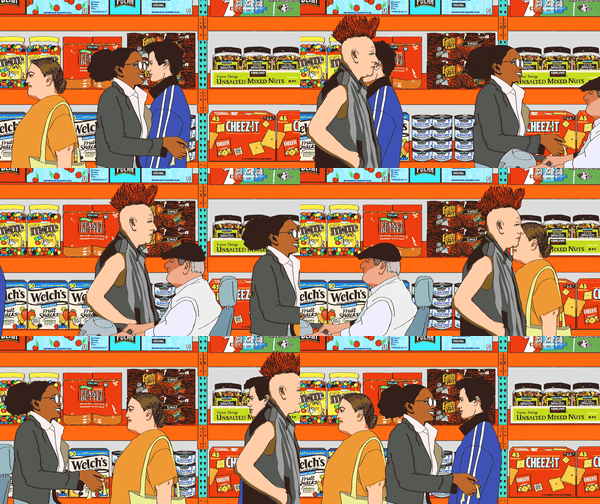 I Want to Live Like Costco People
Some of us are crying in H Mart; some of us are mourning in Costco.
 Preaching in the Trump era
How to address politics without driving hearers away
Note: the author has been an episcopal priest since 1977.